

In an industrial gas system if gas pipes are the blood vessels, “gas valves” are the heart and muscles controlling energy flow as required, whether opening and closing, adjusting pressure, or shutting down in an emergency. Business owners and technicians may wonder how many types of gas valves there are and how their functions differ. DeeChoice Group explores gas valves in detail to help you select them correctly, precisely, and safely.
What Is a Gas Valve, and Why Is It Important?
A gas valve is a mechanical device installed in a gas piping system to control fluid movement. It can direct, start, or stop flow and adjust pressure and flow rate to suit demand. Beyond operational control, valves are vital safety devices for emergency shutdown, leak prevention, and keeping system pressure within safe limits.
Types of Gas Valves: Essential Valves in LPG Systems
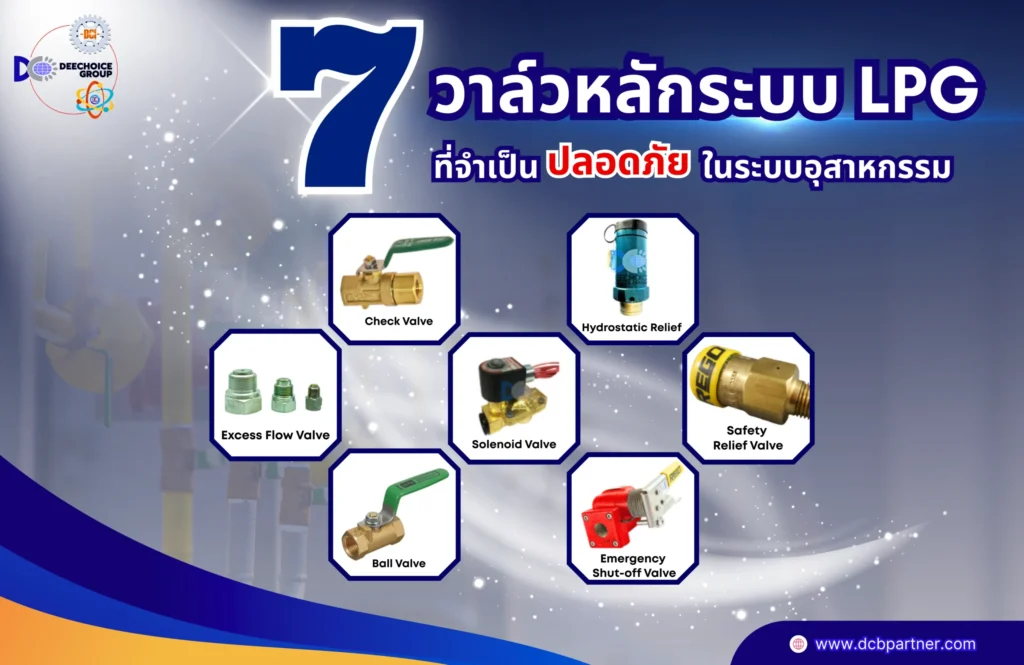
The number of gas valve types depends on how they are classified by function and construction. In industrial LPG systems, the following main types should be understood and used for their intended purposes to achieve efficiency and safety:
Ball Valve
A Ball Valve is one of the most common and widely used gas valves. Inside is a ball with a central bore that blocks or permits flow. It opens or closes quickly with a 90-degree turn (Quarter-turn), provides Tight Shut-off, and has low flow resistance. It is suitable for system Isolation or rapid gas shutoff.
Safety Relief Valve
A Safety Relief Valve protects gas vessels and piping from explosion. Its main function is automatically releasing excess pressure when pressure exceeds the Set Pressure, for example due to external heat or another equipment fault. It closes automatically once pressure returns to normal. These valves are legally required on every gas storage vessel.
Check Valve
A Check Valve permits gas to flow in only one direction and prevents Backflow. It is commonly installed after a gas transfer pump or wherever reverse contamination of the supply must be prevented.
Solenoid Valve
A Solenoid Valve is electrically operated and used for remote automatic gas on-off control or as part of an automated control system. For example, when a Gas Detector detects danger, it sends an electrical signal to close the gas supply immediately. It is a key component of modern safety systems in factories, buildings, and leased commercial units.
Emergency Shut-off Valve
An Emergency Shut-off Valve is designed to stop gas supply at its source, usually at the bottom of a gas tank or on the main supply pipe, in an accident or fire. It may be activated in several ways: a Thermal link melts in a fire to close the valve, a pull cable is operated, or a pneumatic signal is applied. This stops large quantities of gas from escaping.
Excess Flow Valve
An Excess Flow Valve is a small but critical safety device that automatically stops gas flow when the flow rate becomes abnormally high, typically because a gas pipe breaks or disconnects. It helps prevent a major release that could lead to an explosion and is often installed inside a cylinder valve or supply connection.
Hydrostatic Relief Valve
A Hydrostatic Relief Valve differs from a Safety Relief Valve because it protects against pressure caused by expansion of “liquid gas” (liquid LPG) trapped in a pipe when valves at both ends are closed (Liquid Thermal Expansion). Without it, heat-induced expansion of the trapped liquid could rupture the pipe or cause an explosion.
How to Select a Gas Valve for Your Application
After understanding the different types, the next step is choosing correctly, because using the wrong valve can have disastrous consequences.
Consider the Application
Define what the valve must do. For fully open or fully closed isolation, choose a ball valve or gate valve. For throttling flow, choose a globe valve or needle valve for precise control and to prevent valve damage.
Consider System Pressure and Temperature
Liquid and vapor LPG conditions involve different pressures, and operating temperature affects internal seal materials. Check that the valve specifications can withstand the system’s maximum operating pressure. Normally, LPG gas equipment must withstand at least 400 PSI or meet the applicable specified standard.
Choose Durable Materials Meeting International Standards
Valve bodies must withstand corrosion and pressure. Industrial LPG applications commonly use Ductile Iron, Carbon Steel, or Stainless Steel. Avoid low-grade brass valves not certified for gas service. Internal seals must also resist petroleum products, such as PTFE or Viton, to prevent swelling or deterioration.
Signs of Valve Deterioration and Maintenance Precautions
Even high-quality valves deteriorate with time. Watch for the following abnormalities:
- Gas Odor: A gas odor around the valve stem or connections may indicate worn seals or loose threads.
- Stiff Valve Stem: Unusual difficulty opening or closing may be caused by internal rust or dried grease. Never force it with locking pliers, as the stem may break.
- Unusual Noise: Hissing or a high-pitched whistle during use may indicate an Internal Leak or incomplete valve closure.
- Rust or Corrosion: If deep corrosion is visible on the valve body, replace it promptly to prevent rupture.
Frequently Asked Questions (FAQ)
What Certifications Should a Quality LPG Valve Have?
Look for recognized standards such as UL (Underwriters Laboratories) for safety, API for petroleum applications, or Thai Industrial Standards (TIS) to confirm quality and safety.
How Do Industrial Gas Valves Differ from Household Valves?
Industrial valves are designed for much higher pressures and flow rates, use stronger materials, and have more complex safety systems than the small brass valves used in homes.
How Often Should Gas Valves Be Replaced?
Quality valves generally have a service life of 5-10 years, but should be inspected annually. If abnormalities are found or a leak test fails, replace the valve immediately without waiting for the end of its expected life.
Conclusion: Consult Specialists When Choosing Quality Gas Valves
Understanding the types of gas valves is only the first step toward a safe gas system. Specification, installation, and maintenance require sound engineering knowledge. If you need quality gas valves or advice on factory gas system design, DeeChoice Group’s specialist engineers are ready to help ensure dependable safety whenever a valve opens or closes.
If you are looking for specialists in gas system installation and factory gas piping installation, DeeChoice Group has a specialist team with more than 10 years of experience. We use high-quality products that meet Department of Energy Business standards and provide attentive service, because standards and safety are central to our work. For more information, contact us through the following channels:
- Call 061-830-2626 (Sales)
- Line ID: @dcbpartner (Service)
- Facebook: Deechoice Group
- E-mail: Sales@dcbpartner.com