


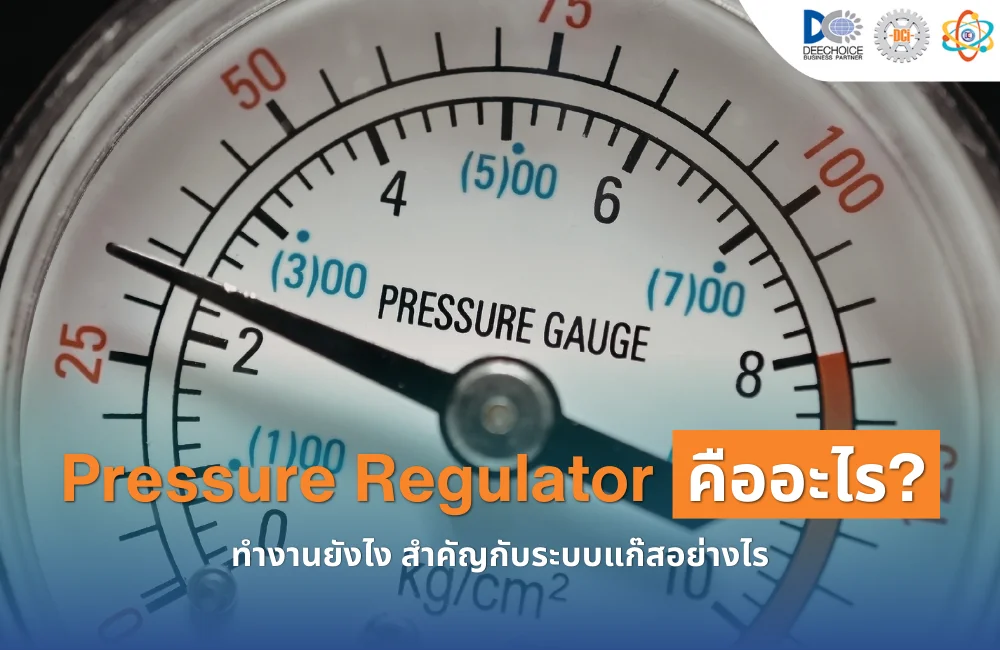
In industrial gas supply systems, whether in manufacturing plants, hotels, or large facilities, consistent pressure is essential for efficient and safe machinery operation. Many people are familiar with on-off valves, but the device that truly “controls the game” is the “Pressure Regulator”. This article explains what a pressure regulator is, how it works, and why it is indispensable when designing a gas system that meets applicable standards.
What Is a Pressure Regulator?
Simply put, a pressure regulator is a “pressure-reducing valve”. It reduces gas pressure from the supply, such as a cylinder with high and variable pressure, to a “constant” and “suitable” operating pressure set for downstream equipment, regardless of changes in inlet pressure or flow rate. It acts as a barrier that continually balances the energy supplied with demand, protecting equipment from excessive pressure.
How a Pressure Regulator Works in a Gas System
To understand a pressure regulator more thoroughly, we need to examine its internal mechanism. The basic principle is a “balance of forces” between the spring force, or gas pressure in the actuator, that tries to open the valve and the outlet gas pressure acting on the diaphragm that tries to close it. As gas is used, outlet pressure falls, allowing the spring to open the valve further and increase gas flow until pressure returns to its set level. This process takes place continuously and rapidly to keep pressure as steady as possible.
Key Internal Components
This precise operation relies on 3 main components working together:
- Loading Element: Usually a spring or gas pressure, this establishes the required pressure setting (Set Point).
- Sensing Element: Usually a rubber diaphragm, this senses and measures outlet gas pressure and transmits feedback to the control mechanism.
- Control Element: The valve plug and seat (Valve Plug & Seat) open or restrict the gas passage in response to the diaphragm.
Types of Pressure Regulators Commonly Used in Industry
Once operators understand what a pressure regulator is, they will find several types available to suit different applications. In industry, regulators are generally divided into 2 main types according to their operating mechanism:
Direct Operated Regulator
This is the most commonly used type because its design is simple and economical. Spring force acts directly on the diaphragm to control valve opening and closing. It suits general applications with moderate flow and relatively stable inlet pressure. Its main advantage is an immediate response to changes in gas demand, although accuracy may decrease slightly when flow varies significantly.
Pilot Operated Regulator
For applications requiring high accuracy and very large flow rates, such as large gas metering stations, this regulator uses a smaller device called a “pilot” to amplify the force controlling the main valve. This maintains highly stable and accurate outlet pressure even when inlet pressure fluctuates substantially or gas flow is very high.
The Important Role of Pressure Regulators
Some people overlook the true importance of a pressure regulator beyond simply reducing pressure. In fact, it plays a vital role in a factory’s “production quality” and “safety”.
Maintaining Flame Stability and Thermal Efficiency
In heat-based processes such as paint curing ovens, melting furnaces, and boilers, flame quality directly affects product quality. Fluctuating gas pressure causes an uneven flame and unstable temperatures, potentially damaging products. A pressure regulator keeps pressure steady, promotes complete combustion, provides stable heat output, and helps save fuel.
Protecting the System and Downstream Equipment from Overpressure
Downstream gas equipment, including burners and machinery, is designed to withstand limited pressure. Without a pressure regulator, high cylinder pressure could damage seals, valves, or internal machinery components, or even cause an explosion. An important role of the regulator is therefore to serve as a first line of protection for assets.
How to Choose the Right Pressure Regulator
Understanding what a pressure regulator is is only the starting point. Practical use requires selecting the correct specifications. DeeChoice Group’s engineering team recommends considering the following factors:
Consider the Required Inlet & Outlet Pressure
You must know the maximum supply pressure (Inlet Pressure) to select a body with an adequate pressure rating. You must also specify the operating pressure (Outlet Pressure) required by downstream equipment to choose a suitable Spring Range. Selecting the wrong range can prevent proper adjustment or cause the valve to malfunction.
Assess Flow Rate Capacity
The same pipe size does not necessarily mean the same gas supply capacity. Check each model’s flow coefficient (Cv) or Flow Capacity table to ensure it can meet the system’s maximum gas demand (Max Flow). An undersized regulator can cause a Pressure Drop when several machines operate simultaneously.
Check Gas and Material Compatibility (Material Selection)
Seal and diaphragm materials must withstand the chemical properties of the gas used. For LPG, the standard material is often Nitrile (NBR). For other corrosive gases or extremely high or low temperatures, suitable special materials are needed to prevent swelling or tearing.
Frequently Asked Questions (FAQ)
How Does a Pressure Regulator Differ from an Ordinary On-Off Valve?
An on-off valve simply stops or allows gas flow. A pressure regulator automatically “adjusts” gas pressure to maintain its set level, regardless of changes in upstream pressure.
What Are the Warning Signs of a Faulty Pressure Regulator?
Common symptoms include being unable to increase the pressure setting, pressure creeping upward while the downstream valve is closed, or a gas odor near the vent, which may indicate a torn diaphragm.
Is a Pressure Gauge Required Alongside a Regulator?
Yes. Pressure gauges should be installed on both the inlet and outlet sides to monitor performance, adjust settings, and diagnose abnormal pressure.
Conclusion
A thorough understanding of what a pressure regulator is and why it matters shows that this device is central to the stability and safety of the entire gas system. Selecting quality equipment suited to the engineering application is therefore essential.
If you need advice on choosing a pressure regulator or designing an industrial gas system, DeeChoice Group has a specialist team with more than 10 years of experience. We use high-quality products that meet Department of Energy Business standards and provide attentive service, because standards and safety are central to our work. For more information, contact us through the following channels:
- Call 061-830-2626 (Sales)
- Line ID: @dcbpartner (Service)
- Facebook: Deechoice Group
- E-mail: Sales@dcbpartner.com