

Efficient and safe gas use depends not only on the cylinder or stove, but also on a vital intermediary: the “gas pressure regulator”. Business owners and technicians often wonder which type best suits their application. Choosing the wrong type can mean a weak flame, interrupted machinery operation, or even an accident. DeeChoice Group introduces this gas equipment in detail to help you make an informed, professional choice.
What Is a Gas Pressure Regulator, and Why Is It So Important?
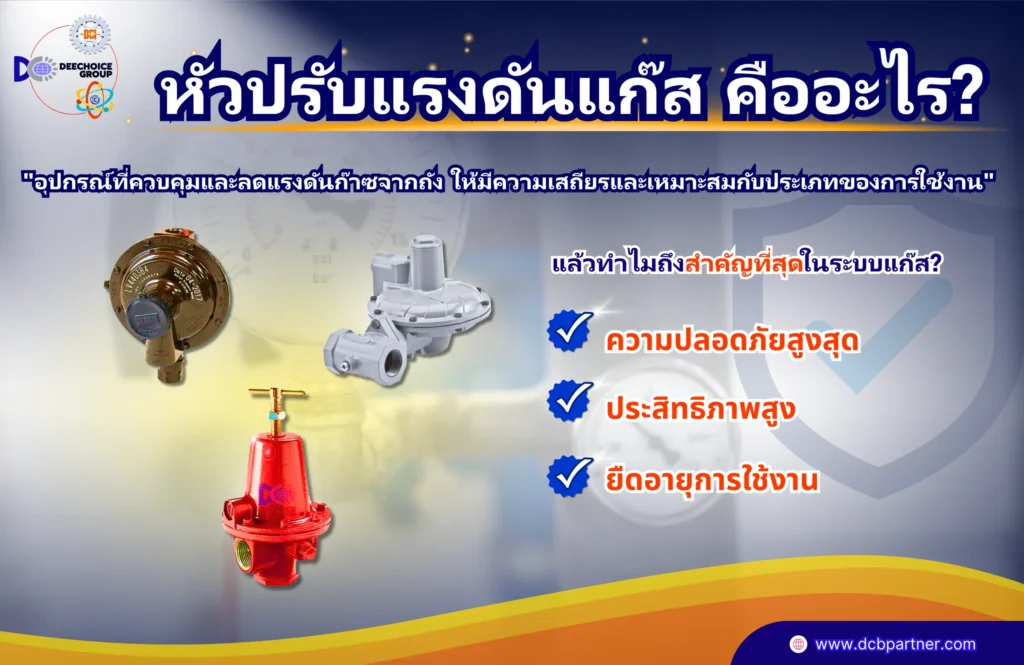
A gas pressure regulator controls and reduces the pressure of gas leaving a storage cylinder, where pressure is high and varies with temperature, to a stable level suitable for downstream equipment. This may be a household stove or industrial machinery. Its most important function is maintaining stable flames and heat. Without a regulator, or with the wrong type, pressure may be dangerously high or too low for equipment to operate.
What Types of Gas Pressure Regulators Are Available?
Before deciding which regulator to buy, first understand the available types and what each is designed to do. In industrial and commercial applications, regulators can generally be classified by operating pressure and function as follows:
Low Pressure Regulator
This is the most familiar type, commonly used with household stoves, baking ovens, or water heaters that need a steady, gentle flame. It reduces cylinder pressure to approximately 300-500 millimeters of water (mmH2O), or around 0.04 bar. It usually has no adjustment knob on top. Using it with a stove that requires high heat will produce a weak flame and incomplete combustion.
High Pressure Regulator
Designed for equipment requiring strong, rapid heat, such as commercial cooking stoves, high-output burners, restaurant wok ranges, or industrial burners. These regulators supply gas at much higher pressure than low-pressure models, potentially up to 2 bar or more. They usually have a top knob to increase or reduce pressure. They must never be used with domestic gas appliances or household stoves, as this could cause an explosion.
Automatic Changeover Regulator
For businesses requiring uninterrupted gas supply 24 hours a day, even when a cylinder empties, this is an ideal solution. Installed between 2 banks of cylinders, it automatically switches to the other bank when one runs out. A colored indicator shows when empty cylinders need replacement, allowing production to continue without interruption.
How to Choose the Right Gas Pressure Regulator for Your Business
After learning about the different types, the next step is to assess the factors that determine the best model for your application. Consider these 4 key points:
1. Understand Gas Demand (Flow Rate)
Determine how many kilograms of gas per hour (kg/hr) the downstream equipment, such as stoves or machinery, requires. A suitable regulator should supply slightly more than the system’s maximum demand. A regulator with insufficient flow capacity can cause unstable flames, pressure drops, and machinery malfunctions.
2. Understand Inlet & Outlet Pressure
Check the pressure in the storage cylinder or supply pipe (Inlet Pressure) and the pressure required by downstream equipment (Outlet Pressure). Each regulator has a limited inlet pressure range and outlet adjustment range. These must match the application for maximum safety and efficiency.
3. Match the Regulator to the Gas Type
Although LPG is the most widely used gas, some factories use natural gas (NG) or other industrial gases. Internal materials, such as diaphragms and rubber seals, are designed to withstand the chemical properties of different gases. Clearly specify the gas type when purchasing.
4. Safety Standards & Materials
Safety should never be compromised. Choose a reputable brand with certification to standards such as TIS, UL, or EN. The body should be made of strong metal resistant to corrosion and impact. Consider built-in safety features such as automatic gas shutoff if a hose disconnects or an overpressure relief valve.
Common Problems and Signs of Regulator Deterioration
Even a well-chosen regulator deteriorates over time. Watch for these signs so it can be replaced before a dangerous situation develops:
- Gas Odor: This is the most dangerous warning sign and may indicate a torn internal diaphragm or deteriorated rubber seals.
- Difficulty Adjusting the Flame: A flame that remains too strong at the lowest setting or too weak at the highest setting suggests fatigue in the spring or internal mechanism.
- Unusual Noise: Whistling or fluttering during operation may result from vibration of loose or damaged internal components.
- Unsteady Pressure Gauge Needle: If a pressure gauge is fitted and its needle swings sharply, the regulator may no longer be able to maintain stable pressure.
Frequently Asked Questions (FAQ)
How Do Industrial Regulators Differ from Household Regulators?
Industrial regulators support much higher flow rates, withstand continuous heavy-duty operation, and often include more complex safety systems to address factory risks.
How Long Does a Gas Pressure Regulator Last?
Generally, service life is around 5 years, but the condition should be checked annually. Heavy use or corrosive environments may shorten its life.
When Should a Gas Pressure Regulator Be Replaced?
Replace it immediately if abnormalities occur, such as leakage or loss of pressure control, or when it reaches the service life specified by the manufacturer. Do not wait until it fails completely.
Conclusion
There is no single answer to which gas pressure regulator is best for everyone. The choice depends on understanding your gas system including pressure type, gas demand, and safety standards. If you are unsure or need advice on factory gas equipment, DeeChoice Group’s specialists can help you select a regulator that is “right” and “safe” for your business.
If you are looking for specialists in gas system installation and factory gas piping installation, DeeChoice Group has a specialist team with more than 10 years of experience. We use high-quality products that meet Department of Energy Business standards and provide attentive service, because standards and safety are central to our work. For more information, contact us through the following channels:
- Call 061-830-2626 (Sales)
- Line ID: @dcbpartner (Service)
- Facebook: Deechoice Group
- E-mail: Sales@dcbpartner.com